
If you’re researching stock prices, cryptocurrency, gold, silver, or financial market trends, you may have come across FintechZoom IO. The website presents itself as a financial information platform that brings market updates, investment topics, and educational resources together in one place. Before using it, though, it’s important to understand what it offers and how to check the information it publishes.
This guide explains the platform’s main features, potential benefits, limitations, and safety considerations for readers in the United States. It also covers an important detail that can easily be missed: FintechZoom.io and FintechZoom.com are different domains, and FintechZoom.com publicly states that it is not affiliated with the .io website.
The goal is to help you understand the website without treating promotional claims as proven facts. Financial information can help you ask better questions and compare opportunities, but it shouldn’t replace independent research or professional financial advice.
What Is FintechZoom IO?
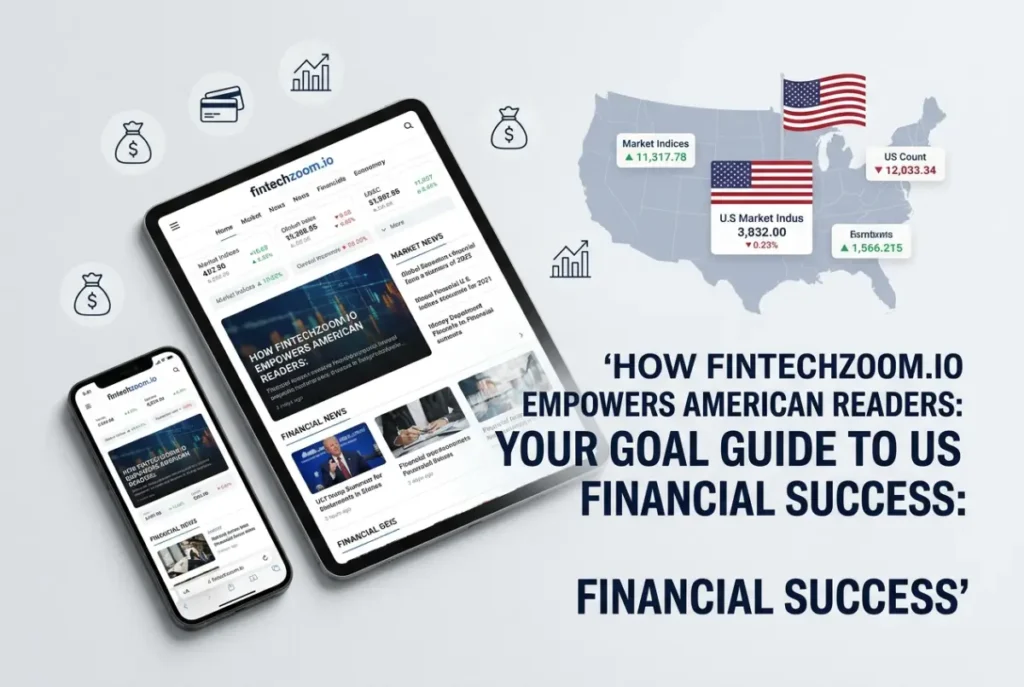
FintechZoom IO is a website that focuses on financial markets, investing topics, and financial technology. Its homepage features information about major stock market indexes, cryptocurrency, precious metals, and real estate. It also promotes financial education and trading courses.
For American readers, these topics connect directly to everyday financial decisions. Someone researching technology stocks may want to understand the Nasdaq. Another reader might be comparing gold with other assets or learning how cryptocurrency markets work.
The website brings several of these subjects together, which can make it a starting point for general research. However, a site’s published features and marketing statements do not automatically prove that its market forecasts are accurate or its services are trustworthy.
There is also a significant identity issue to consider. FintechZoom.com identifies itself as the official domain for its brand and explicitly lists fintechzoom.io among websites it says are not affiliated with it.
That warning deserves attention before you sign up, purchase a course, share personal information, or act on an investment recommendation.

What Does FintechZoom IO Cover?
The platform’s main areas of interest include stock markets, digital assets, commodities, property, and financial education. Each category serves a different research purpose.
Stock market news and indexes
The website discusses the Nasdaq and Dow Jones Industrial Average, along with individual companies such as Apple and Tesla. These subjects can help readers explore stock market movements, company performance, and broader investor sentiment.
FintechZoom IO
Cryptocurrency and blockchain
Bitcoin, Ethereum, and other digital assets feature in the site’s crypto coverage. Readers can use this material to learn basic terminology, explore market trends, and investigate developments in blockchain technology.
Gold and silver prices
Precious metals receive attention because investors often study them during periods of inflation, market uncertainty, or changes in interest rates. Their prices can also respond to currency movements, industrial demand, and global events.
Real estate and property markets
Property related topics can help readers explore valuation, housing market conditions, and real estate investment concepts. Actual returns depend on factors such as financing costs, location, maintenance, taxes, and rental demand.
Trading education and courses
The website also advertises learning resources for people interested in trading and investing. Prospective students should review the course details, instructor qualifications, costs, refund policies, and claims about expected results before paying.
These categories create a broad introduction to financial topics. Still, readers should check individual articles and tools instead of assuming every section offers the same level of accuracy, detail, or independent verification.
How the Website May Help American Readers
Financial research can feel overwhelming when information comes from dozens of different sources. A financial website that groups related subjects together may help readers organize their initial research.
For example, a person following a technology company could begin by reviewing its recent performance and then investigate earnings, industry news, interest rates, and changes in investor expectations. A reader researching precious metals could compare recent prices with inflation data and the US dollar’s movement.
Here are several practical ways to approach the platform.
Learning Financial Terms
Beginners often encounter unfamiliar terms such as market capitalization, dividend yield, volatility, exchange traded funds, and blockchain. Educational articles can help explain these concepts before readers move on to more detailed financial research.
The best learning material explains the term, provides a realistic example, and discusses its limitations. A useful article about dividend yield, for instance, should explain that a high yield alone does not guarantee a good investment.
Exploring Market Trends
Market commentary can help readers identify developments worth investigating. Reports about company earnings, inflation, central bank decisions, and changes in commodity prices may provide useful context.
However, a market movement and its explanation are two different things. A stock might fall after an earnings announcement, but the decline could also reflect broader market weakness, investor expectations, or other developments.
Read analysis as an explanation to examine, not as proof of a single cause.
Comparing Financial Topics
A reader interested in long term investing may want to understand the differences between stocks, bonds, real estate, and precious metals. An educational website can provide a starting point for comparing their general characteristics.
The next step is to examine the actual investment products, fees, tax implications, liquidity, and risks. A general article cannot account for every investor’s financial circumstances.
Building a Research Routine
Regular research can help people become more familiar with financial news. Instead of reacting to every headline, readers can follow a manageable list of topics and review important developments at consistent intervals.
A practical routine might include checking major economic announcements, reviewing the companies in a watchlist, and recording questions that require additional research.
The objective is better understanding, not constant trading.
Is FintechZoom IO Legit and Safe to Use?
This question needs a careful answer because it involves more than the existence of a functioning website.
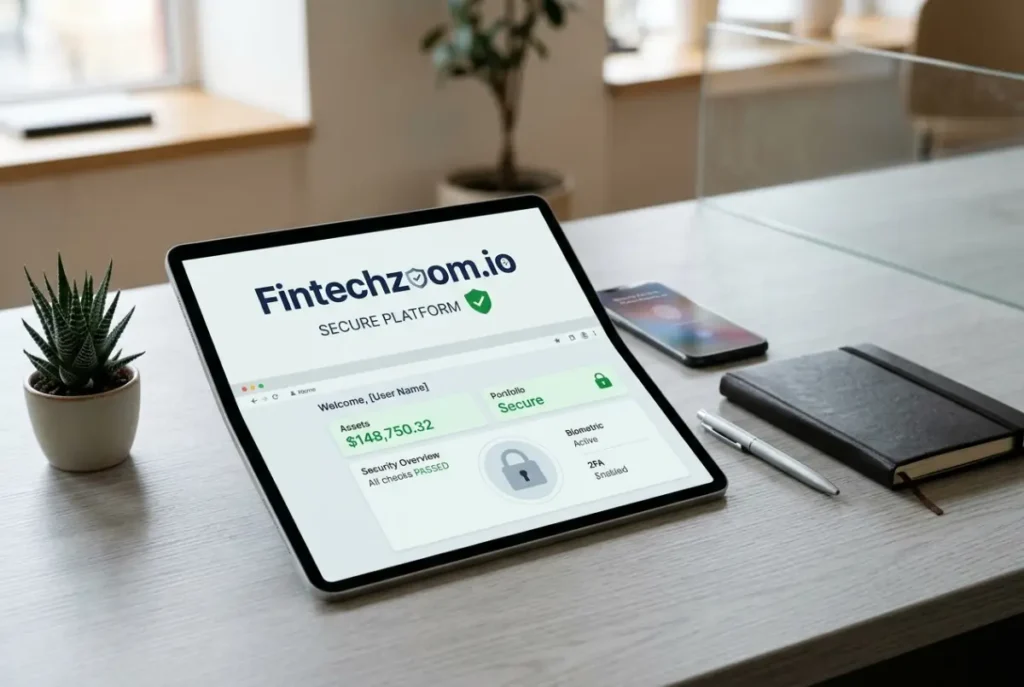
The domain is accessible and publishes financial content. Its own website describes its services, research topics, and educational offerings. Those facts establish what the site presents to visitors, but they do not independently verify the quality of its investment advice or the credentials behind every service.
More importantly, FintechZoom.com has published a warning that specifically identifies fintechzoom.io as a domain that is not affiliated with its website. It advises readers to use the official .com domain and exercise caution around websites using similar names.
This does not, by itself, establish that every page on the .io website is fraudulent. It does mean you should not assume that the two websites share ownership, authorization, security practices, or editorial standards.
Before using the platform, consider these checks.
- Verify the domain. Read the complete address in your browser instead of relying on a logo, search result title, or familiar brand name.
- Check the people behind the content. Look for identifiable authors, relevant qualifications, and evidence supporting their financial claims.
- Review the service terms. Read fees, cancellation rules, refund conditions, privacy policies, and any contract before making a commitment.
- Examine investment claims. Be skeptical of guaranteed profits, unusually high success rates, or promises that a system can consistently predict market movements.
- Protect personal information. Do not provide banking passwords, account recovery codes, cryptocurrency seed phrases, or unnecessary identity documents.
- Verify financial services independently. Check the relevant regulatory records and official company information before trusting a business with your money.
For US consumers, the SEC’s Investor.gov is a useful starting point for investment education and fraud prevention. The FINRA BrokerCheck database can help you research registered brokerage firms and certain financial professionals.
A website’s appearance, secure connection, or professional language is not sufficient proof of financial legitimacy.
Main Benefits and Limitations
A fair review should consider what a financial information website can do well and where readers need to be careful.
| Potential benefit | Important limitation |
|---|---|
| Several financial topics in one place | Broad coverage does not guarantee depth or accuracy |
| Introductory investment information | Educational articles may not suit individual financial needs |
| Market commentary and chart access | Displayed prices may need independent verification |
| Exposure to stocks and digital assets | Market forecasts can be wrong |
| Advertised financial courses | Course quality and credentials require separate checks |
| A starting point for research | Readers still need reliable primary sources |
The Benefits
The main attraction is convenience. Readers can explore several financial subjects without beginning a new search for every question.
The site also covers topics that may interest different audiences. A beginner might want to understand how stock indexes work, while a more experienced reader may be looking for company analysis or information about digital assets.
Financial education can also encourage better questions. Someone who learns how interest rates affect borrowing costs may become more interested in Federal Reserve announcements, mortgage rates, or bond yields.
These are useful outcomes when the material helps readers understand a subject rather than pushing them toward a particular transaction.
The Limitations
The first limitation is verification. A published price, chart, forecast, or claim about a company’s performance needs a reliable source and a clear date.
The second is the difference between education and personalized financial guidance. General information cannot account for your income, debts, investment horizon, tax situation, and ability to absorb losses.
The third concerns the site’s relationship to the established FintechZoom.com brand. The publicly stated lack of affiliation makes it especially important to evaluate the .io domain on its own merits.
Finally, predictions deserve particular caution. Financial markets respond to changing expectations, economic conditions, company results, and unexpected events. No website can reliably eliminate that uncertainty.
For these reasons, fintechzoom io is best approached as a subject for careful evaluation rather than an automatic source of trustworthy investment recommendations.
How to Use Financial Market Information Responsibly
Reading financial information is only one part of making sound decisions. You also need a repeatable way to check claims, compare evidence, and understand risk.
Start With a Specific Question
Instead of browsing without a goal, decide what you want to learn.
You might ask:
- Why did a particular stock decline after its earnings report?
- What factors influence the price of gold?
- How does the Nasdaq differ from the Dow Jones Industrial Average?
- What makes cryptocurrency more volatile than many traditional investments?
- How do rising interest rates affect homebuyers?
A focused question makes it easier to separate relevant evidence from unrelated commentary.
Check the Publication Date
Financial information can become outdated quickly. An article describing a company’s quarterly earnings may no longer reflect its latest results. A discussion of interest rates may predate a Federal Reserve announcement.
Always check the date of publication and look for later updates. When reviewing a market price, confirm the time of the quote and the exchange or data source.
This matters particularly when markets are moving quickly. A number that was accurate earlier in the day may no longer reflect the current trading price.
Compare Claims With Primary Sources
Primary sources provide information directly from the organization responsible for it. They are often the best place to verify important claims.
For US market research, useful sources include:
- US Securities and Exchange Commission: Company filings, financial disclosures, and investor protection resources.
- Federal Reserve: Monetary policy decisions, economic data, and research.
- Bureau of Labor Statistics: Employment, inflation, and other economic statistics.
- US Treasury: Information about government debt, Treasury securities, and fiscal policy.
- FINRA: Investor education and information about brokerage related risks.
For example, if an article claims that a company’s revenue increased sharply, review its latest filing or earnings release. If an article attributes market movements to inflation, compare that explanation with the relevant economic data and other credible reporting.
You do not need to investigate every sentence in every article. Focus on the claims that could materially affect your understanding or financial decisions.
Separate Facts From Forecasts
Financial content often mixes historical data with predictions. These are not interchangeable.
A statement that a company reported a certain level of revenue is a factual claim that can be checked against its financial statements. A statement that its stock will rise next month is a forecast based on assumptions.
Good analysis explains those assumptions and acknowledges possible alternative outcomes. Weak analysis presents a prediction as a certainty or relies on dramatic language to make an uncertain outcome sound inevitable.
Understand Your Own Risk
Even accurate information can lead to a poor decision if it does not fit your circumstances.
A volatile investment may be unsuitable for money needed to pay rent, cover an emergency, or meet a near term expense. An investment that looks attractive on paper may also carry fees, tax consequences, or liquidity restrictions that reduce its practical value.
Before committing money, consider the potential loss, the time you can leave the money invested, and the purpose of the investment.
For complex decisions, consult a qualified financial professional whose credentials and regulatory status you have independently verified.
FintechZoom IO vs FintechZoom.com
One of the most important distinctions for readers is the difference between the two domains.
Although their names are similar, fintechzoom io and FintechZoom.com should not be treated as interchangeable websites. The .io website publishes financial market content and promotes courses, while FintechZoom.com identifies itself as the official website for its brand and publicly denies affiliation with the .io domain.
FintechZoom.io
The .io domain
The website presents stock market coverage, cryptocurrency information, precious metals content, real estate topics, and educational offerings. Its relationship to the .com brand should not be assumed.
FintechZoom.com
The .com domain
The website publishes financial news and analysis. It states that fintechzoom.io is not affiliated with it and lists the .io domain in its security warning.
Read the published security warning
The practical lesson is simple: check the full URL before you rely on a brand name. A similar domain does not establish common ownership, authorization, or a shared reputation.
If you intended to visit the .com website, type its address directly into your browser instead of following an unfamiliar link. If you specifically want to investigate the .io website, assess its own disclosures, services, and claims independently.
Is FintechZoom IO Good for Beginners?
A beginner can benefit from reading financial articles, learning market terminology, and exploring different asset classes. However, the suitability of any particular website depends on the accuracy, clarity, and transparency of the material being used.
New investors should start with basic concepts before attempting to predict prices or trade frequently.
For example, learn how stocks represent ownership in companies, how bonds work, why interest rates matter, and how diversification can reduce some forms of portfolio risk. Understand the difference between an investment and a speculative trade.
It also helps to know the limits of financial charts. A chart shows historical price movements. It does not guarantee future performance, and a pattern that appears meaningful in hindsight may not predict what happens next.
Beginners should be especially cautious around paid trading courses that promise unusually strong results. Before enrolling, investigate the instructor’s background, the actual syllabus, the total cost, the refund terms, and any independent evidence supporting the advertised outcomes.
The same standard applies to free content. Free access does not make information reliable, and paid access does not make it accurate.
A strong learning resource should explain its reasoning, identify its sources, discuss risk, and make uncertainty clear.
How to Identify Financial Red Flags
Financial websites can present information in a polished, professional format. That does not mean every claim deserves your trust. A few warning signs should prompt you to slow down and investigate.
Guaranteed investment profits. No legitimate market analysis can guarantee that stocks, cryptocurrency, gold, or other assets will produce a particular return.
Pressure to act immediately. Messages that insist you must deposit money now to avoid missing a once in a lifetime opportunity deserve extra scrutiny.
Unclear ownership. If you cannot establish who operates a website, who is responsible for its content, or how to contact the business, be cautious about sharing sensitive information.
Unverified success stories. Testimonials about investors becoming wealthy do not establish that a strategy works consistently. Look for independent evidence, including information about losses and risks.
Requests for sensitive credentials. Never share your banking password, one time verification code, or cryptocurrency recovery phrase with someone claiming to provide investment assistance.
Unexplained fees. Before paying for a course, subscription, or service, confirm the full cost and understand the cancellation and refund terms.
These checks are useful beyond fintechzoom io. They apply to financial newsletters, trading communities, investment apps, online courses, and social media accounts that discuss money.
If you suspect investment fraud, preserve relevant messages and payment records. US consumers can report suspected securities fraud to the SEC and other relevant authorities. If you have already shared financial credentials, contact your financial institution through its verified website or phone number.
Frequently Asked Questions
What is fintechzoom io?
FintechZoom.io is a website that publishes material about financial markets, stocks, cryptocurrency, precious metals, real estate, and investing education. It also advertises courses and financial learning resources. Readers should verify important claims independently and review the site’s business disclosures before paying for services or sharing personal information.
Is FintechZoom.io the same as FintechZoom.com?
No. They use different domain extensions and should be treated as separate websites. FintechZoom.com publicly states that the .io website is not affiliated with its brand. Readers should verify the complete web address and avoid assuming that the two sites share ownership or credentials.
Can I use fintechzoom io to research stocks?
You can examine the stock market information and commentary published on the website. However, verify company figures against official earnings reports and SEC filings. Compare market prices with reliable exchange or brokerage data, and remember that commentary is not a guarantee of future performance.
Does the website cover cryptocurrency?
Yes. Its published content includes Bitcoin, Ethereum, and other cryptocurrency topics.
FintechZoom IO Before acting on any crypto related claim, check current market information, investigate the risks, and be particularly cautious about promises of guaranteed returns or requests to transfer digital assets.
Does FintechZoom.io offer investment courses?
The website advertises financial education and trading courses.
+1 Anyone considering a purchase should verify the instructor’s qualifications, review the complete syllabus, compare prices, and read the refund policy. Promotional descriptions alone do not prove that a course will produce profitable trading results.
Is FintechZoom.io safe for US investors?
Its safety and reliability should not be assumed from its appearance or published claims. The publicly available warning from FintechZoom.com about the lack of affiliation is an important reason to exercise caution. Avoid sharing sensitive financial details, independently verify services, and use established regulatory resources before making financial commitments.
Can the website predict stock prices accurately?
The website describes tools and content related to market analysis and price projections. However, those descriptions do not independently establish predictive accuracy. Ask for a transparent methodology, verifiable historical results, and information about losses. No forecast can remove the uncertainty inherent in financial markets.
Is FintechZoom.io a broker or bank?
Its public website presents itself as a financial information and education platform. That presentation alone does not establish that it is a licensed bank, broker, or investment adviser. Verify the exact legal entity and the relevant registration before using any service that claims to provide regulated financial activities.
What are the best alternatives for verifying financial information?
For US readers, useful resources include the SEC for company filings, the Federal Reserve for monetary policy, the Bureau of Labor Statistics for inflation and employment data, and FINRA for investor education. These sources help you check important claims instead of relying on a single publication.
Should I pay for a financial research course?
Consider paying only after reviewing the course content, instructor credentials, full cost, and refund conditions. Be skeptical of guaranteed returns and claims that a course will make you wealthy quickly. Free resources from established financial regulators can help you learn basic investing concepts before spending money.
Final Verdict
FintechZoom IO covers a range of financial subjects that may interest American readers, from stock market analysis and cryptocurrency to precious metals and trading education. Its broad selection of topics can serve as a starting point for learning about financial markets.
However, the distinction between fintechzoom io and FintechZoom.com is important. The .com website has publicly stated that the .io domain is not affiliated with it. That warning should be considered before you trust the site’s identity, purchase its services, or share sensitive information.
The smartest approach is to verify ownership, check sources, investigate financial claims, and compare information with established institutions. Treat forecasts as opinions rather than guarantees, and never invest money solely because a website recommends an opportunity.
A financial website is most useful when it helps you understand the evidence and make better informed decisions. Your money deserves more than an attractive chart or a confident prediction.