
Finding useful information online should be simple. Yet when a website name appears in search results, it is not always clear what the site does, who operates it, or how much trust it deserves. Readers want straightforward answers before spending time on an unfamiliar platform.
That is one reason people search for yonosamachar com. The name suggests a connection to news and information, but the website has also been described by third party sources as a broader publishing platform covering several subjects. These descriptions give readers a starting point, although they do not establish every detail about the website or its ownership.
For readers in the United States, understanding an unfamiliar website requires more than recognizing its name. It helps to know what content it publishes, how to assess its articles, and how to distinguish useful information from claims that need further verification.
This guide examines the available information about the platform, explains what readers may expect from a multi topic publishing website, and shares practical ways to evaluate its reliability. It also addresses common questions about online safety, financial information, search visibility, and the difference between a general information website and an established news organization.
The goal is simple: give you enough context to make an informed decision without treating unverified claims as established facts.

What Is Yonosamachar.Com?
Yonosamachar Com is a name associated with an online publishing website. Third party descriptions characterize the platform as a general interest publication that covers multiple subject areas instead of focusing exclusively on one specialized topic. These descriptions mention categories such as business, finance, technology, education, entertainment, lifestyle, fashion, and automotive information.
A website with this kind of structure can serve readers who want introductory explanations, practical guides, and general information in one place. For example, someone might read an article about a technology trend, then explore a business topic or look for information about a consumer service.
However, a broad publishing model does not automatically make a website a dedicated news source. Some publications focus on original reporting and breaking events, while others concentrate on evergreen articles that answer questions people search for throughout the year.
That distinction matters because readers should understand the purpose of a website before relying on its content. A general information article may be useful for learning basic concepts, but a report about a major financial decision, government policy, or developing news story needs stronger verification.
One important limitation deserves attention. The available search results do not independently establish all details about the website’s current operation, editorial standards, ownership, or complete article archive. Its precise status and publishing practices should therefore be checked directly rather than assumed.
In practical terms, treat the platform as a potential source of general information and assess its individual articles before using them to make important decisions.
Why Are People Searching for This Website?
People search for website names for several reasons. Sometimes they have seen a name in a social media post. Other times, they encounter a reference in another article or discover the name while researching a particular subject.
Searches for yonosamachar com may reflect several common intentions.
They Want to Identify the Website
The most direct reason is curiosity. A reader sees the name and wants to know what it represents, what appears on the website, and what kind of information it provides.
A clear overview helps answer those basic questions before the reader visits an unfamiliar domain.
They Are Looking for News and Updates
The word samachar is commonly associated with news or information in several South Asian languages. That association can lead readers to expect current affairs coverage or news updates.
However, a website’s name does not prove that it operates as a newsroom. Readers should examine its actual articles, publication dates, sources, and reporting practices before deciding how to classify it.
They Want Information Across Different Topics
Some readers prefer websites that publish articles across several categories. A broad selection can make it easier to discover information without visiting a different website for every subject.
The tradeoff is that broad coverage can vary in quality. A website might offer a helpful introductory guide in one category and a less detailed article in another. Each page deserves its own assessment.
They Want to Check the Website’s Legitimacy
Another common reason for searching a website name is to determine if it appears trustworthy.
Readers may want to know who owns the domain, if the website protects personal information, and if its articles contain accurate details. These are sensible questions, especially when a website discusses financial products, health topics, or other subjects that can affect real decisions.
Search results can provide clues, but they are not a substitute for checking the website and verifying its claims.

Main Topics Readers May Find
Third party descriptions present the website as a multi category publisher. The following overview explains the types of information associated with this publishing model. It does not guarantee that every category is currently available or that every subject receives regular updates.
Technology and Digital Trends
Technology articles can explain software, websites, online tools, digital services, and emerging trends. Useful guides should identify the product or service being discussed, explain its main features, and distinguish verified facts from predictions.
Business and Entrepreneurship
Business content may cover companies, small business operations, workplace practices, marketing, and entrepreneurship. Readers benefit most from clear explanations supported by credible examples and current information.
Finance and Banking
Financial articles can explain basic money concepts, banking services, lending, and investing. Readers should verify rates, fees, eligibility requirements, and financial product details with the relevant institution before acting.
Education and General Knowledge
Educational guides can introduce unfamiliar subjects, explain terminology, and help readers understand common questions. Strong articles use clear examples and link to dependable references when claims need evidence.
Entertainment and Lifestyle
These subjects can include television, movies, popular culture, personal interests, travel, and everyday living. Readers should pay attention to publication dates when information relates to current releases, events, or changing services.
Automotive and Consumer Information
Articles in this area may explain vehicles, buying considerations, ownership costs, or related services. Before making a purchase, compare the information with manufacturer specifications, official records, and independent reviews.
The main advantage of a multi topic website is convenience. Readers can explore different interests from one publication. Its main challenge is consistency: covering many subjects well requires careful research, qualified contributors, and appropriate editorial review.
For that reason, a long list of categories should be treated as a description of a website’s scope, not proof that it has specialist expertise in every field.
How the Website May Fit Into Your Reading Routine
An unfamiliar information website can be useful as a starting point for research. The key is to use it for the right purpose.
Imagine that you are researching a new software tool. A general article might explain what the tool does, describe its basic functions, and introduce terminology you have not encountered before. That information can help you understand the subject.
Your next step should be to check the software company’s official documentation for technical details, pricing, compatibility, and privacy terms.
The same approach works for other topics.
When reading about a business trend, compare the explanation with reputable business reporting or primary research. For information about a government program, check the relevant government website to confirm eligibility and application requirements. If an article makes a financial claim, verify the details with the bank, regulator, or financial institution involved.
This method lets you benefit from accessible explanations without giving an unfamiliar source more authority than it has earned.
A useful rule is to separate learning about a subject from making a decision based on that subject. General articles can help with the first task. Important decisions usually require stronger evidence.
Is Yonosamachar Com a Reliable Website?
Reliability cannot be established from a domain name or a search result alone. It depends on factors such as factual accuracy, source quality, editorial transparency, author expertise, and the way the website handles corrections.
The available third party descriptions provide some information about the site’s apparent publishing model, but they do not establish a complete, independent assessment of its editorial standards.
Consequently, it would be premature to label the entire website trustworthy or untrustworthy without examining its actual pages and supporting evidence.
Instead, assess the following signals.
Check the Author’s Background
Look for an author name and a biography that explains relevant experience. An article about software security, for example, should ideally reflect a sound understanding of the technology involved.
An author biography is not proof of expertise, but it gives readers a starting point for evaluating qualifications.
Look for Supporting Sources
Good informational articles explain important claims and identify where their evidence comes from. Links to official documents, original research, recognized institutions, and primary sources make claims easier to verify.
Be cautious when an article makes strong statements but offers no supporting evidence.
Examine the Publication Date
Dates matter because information changes. A general explanation of a basic concept may remain useful for years, while information about tax rules, interest rates, software updates, or public policies can become outdated quickly.
Look for the original publication date and any meaningful update date. A recently changed date does not necessarily mean the entire article has been reviewed.
Review the Website’s Policies
Established publishers often provide accessible contact details, editorial information, privacy policies, and terms of use.
These pages help readers understand who is responsible for the content and how the website handles visitor information. Missing or vague details do not prove wrongdoing, but they can make independent verification more difficult.
Compare Important Claims
Check consequential claims against at least one reliable primary source. For major decisions, consult multiple independent sources with relevant expertise.
If two websites repeat the same unsupported statement, that repetition does not make the claim accurate.
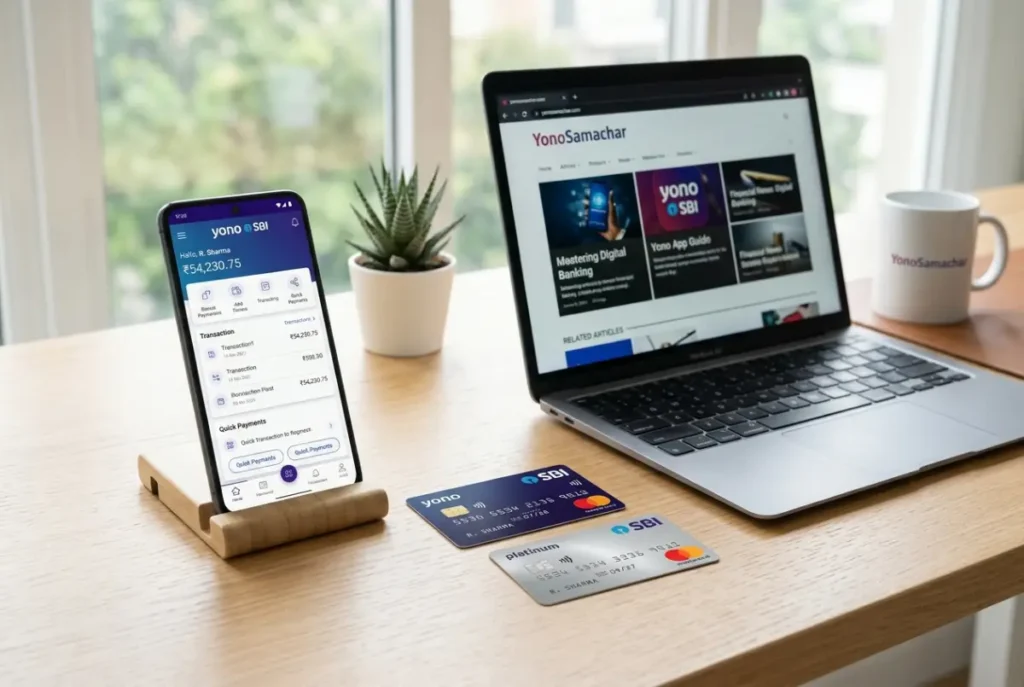
Is It Connected to the SBI YONO Banking App?
The names can cause confusion, particularly for readers familiar with India’s banking services.
SBI’s YONO is associated with the State Bank of India and its digital banking services. However, the similarity between the names YonoSamachar and YONO does not establish a business relationship.
A third party review specifically reports that it found no official SBI source connecting the website with SBI banking.
The practical distinction is important. A website that publishes articles about banking is not necessarily a bank, a banking application, or an authorized financial service.
If you want to access SBI accounts or use official banking features, navigate to the bank’s verified website or official application. Do not enter banking credentials into an unfamiliar site simply because its name contains a familiar word.
For US readers, the same principle applies to domestic financial institutions. Find the bank’s official website independently, confirm the domain, and use its published support channels if you need help.
Never assume that two services share ownership, security standards, or account access because their names look similar.
How to Visit an Unfamiliar Website Safely
Before opening a new website, take a few simple precautions. These habits are useful for any online publication, not just this one.
Verify the domain name.
Check the spelling carefully and make sure you have not landed on a misleading variation of the address.
Check the connection.
HTTPS helps protect information in transit, but it does not prove that a website is honest or that its content is accurate.
Protect personal information.
Do not share passwords, banking details, Social Security numbers, or sensitive documents unless there is a clear, verified reason to do so.
Be careful with downloads.
Avoid unexpected files, browser extensions, and software installers. Use reputable security tools and download software from official sources.
Check links before following them.
Be cautious of pages that redirect unexpectedly, display deceptive alerts, or pressure you to act immediately.
These steps lower common browsing risks, although no single precaution guarantees complete protection. If a website asks for sensitive information that does not fit its stated purpose, leave the page and verify the request independently.
Benefits and Limitations of Multi Topic Websites
A broad publishing website can be helpful, but readers should understand both its strengths and its limitations.
| Potential benefit | Possible limitation |
|---|---|
| Several subjects in one place | Expertise may vary across categories |
| Accessible introductions to unfamiliar topics | Some explanations may lack depth |
| Articles that answer common questions | Information can become outdated |
| Opportunities to discover related subjects | Navigation may feel broad or unfocused |
| Convenient reading on different devices | Website quality depends on its actual design and maintenance |
The strongest benefit is convenience. Readers can discover unfamiliar subjects and build a basic understanding without starting from scratch every time.
The biggest limitation is that breadth does not guarantee depth. A website can publish hundreds of articles without providing the same level of research, expertise, or original reporting in every category.
When evaluating a platform, focus on the usefulness of the specific page you are reading.
Your revised version is clear and natural. It also avoids starting three consecutive sentences with the same word, which should help address the Yoast SEO readability warning.
Those questions are more valuable than judging a website by its size or the number of topics it covers.
What the Website Name Means
The name offers a clue about the type of publication readers might expect.
Samachar is a word commonly used for news or information in several South Asian languages. That meaning helps explain why a reader might associate the name with news coverage. However, a name alone cannot establish a website’s editorial purpose, geographical audience, or ownership.
The broader publishing descriptions associated with the domain suggest a wider range of subjects than traditional news reporting alone.
This is a useful reminder when researching unfamiliar brands. Names can suggest a particular service, but the actual content and independently verifiable information should guide your understanding.
The same principle applies to websites with words such as finance, health, official, or news in their names. Those terms do not automatically establish professional qualifications, regulatory approval, or journalistic credibility.
How to Get the Most Value From Its Articles
If you decide to explore yonosamachar com, approach its content with a clear purpose.
Start by identifying the question you want to answer. Read the relevant article carefully, paying attention to the information it provides and the evidence behind its main claims.
Next, identify details that need confirmation. These may include prices, dates, statistics, legal requirements, product specifications, or statements about financial services.
Then visit the appropriate primary source. Government websites are useful for official rules and public programs. Company documentation is best for product specifications. Recognized medical organizations provide guidance on health topics, while financial institutions and regulators can help verify banking and investment information.
Finally, consider the article’s limitations. A short overview might be enough to explain a basic concept, but a complicated decision may require more detailed research.
This approach makes online reading more productive. Instead of accepting every statement or dismissing every unfamiliar source, you evaluate the evidence and decide how much confidence the information deserves.
Common Questions About Yonosamachar Com
What is yonosamachar com?
It is a website name associated with a general interest publishing platform. Third party descriptions connect it with subjects such as technology, business, finance, education, entertainment, and lifestyle. Its current operation and editorial standards should be verified directly before relying on specific claims.
Does it publish only breaking news?
Available third party descriptions suggest a broader publishing model that includes informational articles across multiple categories. That is different from a newsroom focused on continuous breaking news and original reporting. Readers should examine publication dates, article formats, and reporting practices to understand the site’s actual focus.
Is the website officially connected to SBI YONO?
No official connection has been established by the sources reviewed here. The similarity between the names does not prove that the website belongs to or is endorsed by the State Bank of India. Use verified SBI channels for banking services and account access.
Can readers in the United States access the website?
Access depends on the website’s availability, network conditions, and any restrictions that may apply. If you visit from the United States, check the domain carefully and follow standard browsing precautions. Also consider the geographical relevance of information about local laws, banking services, and government programs.
Is the website safe to visit?
Its overall safety cannot be confirmed from the available descriptions alone. Check the address, review the site’s policies, avoid suspicious downloads, and do not submit sensitive information without verifying the website’s identity and purpose. Remember that HTTPS protects a connection but does not guarantee trustworthy content.
Does it provide accurate information?
Accuracy needs to be assessed article by article. Look for reliable references, qualified authors, current publication dates, and evidence supporting important claims. For decisions involving money, health, law, or personal security, confirm the details through authoritative sources instead of relying on a single general information website.
Is the content useful for beginners?
General interest articles can be useful for readers who want straightforward introductions to unfamiliar subjects. Their value depends on how clearly the author explains the topic and how well the article supports its claims. Beginners should use introductory guides as a starting point and consult specialist sources when they need greater detail.
How can I find the official website?
Search for the exact domain, examine the results carefully, and check that the address matches the intended destination. Avoid assuming that a similarly named website is the official one. If the domain cannot be independently verified, do not enter personal information or follow requests to download software.
Does a broad website have to cover every subject equally well?
No. A publisher can cover many categories while developing different levels of expertise in each one. The number of categories does not establish editorial quality. Check the author’s background, the evidence provided, and the relevance of the article to your question before relying on its conclusions.
What should I do if an article contains questionable claims?
Look for the original source behind the claim and compare it with reputable independent information. Check dates, figures, and the context surrounding quoted statements. If the article offers no verifiable evidence, treat the claim cautiously and avoid sharing it as established fact.
Final Verdict
Yonosamachar com is a website name worth investigating carefully before you rely on its content. Third party descriptions associate it with a multi topic publishing model, covering areas such as technology, business, finance, education, entertainment, and lifestyle. However, those descriptions do not independently establish every detail about its current operation or editorial reliability.
For US readers, the best approach is to use unfamiliar websites as potential starting points for research rather than automatic authorities. Check sources, verify important facts, protect personal information, and consult official organizations for decisions that carry financial, legal, or health consequences.
A useful website should do more than publish information. It should help readers understand a subject, evaluate the evidence, and make informed choices. Until a site’s standards have been established, let the quality of its individual articles guide your level of trust.