
growth navigate often starts with a simple desire to improve something. You might want to build a successful business, advance your career, develop stronger habits, or become more confident in your decisions. The challenge is figuring out where to begin and how to keep moving when progress feels slow.
That is where the idea of growth navigate becomes useful. It combines two important concepts: growth, which involves improvement and development, and navigation, which means finding a direction and choosing the right path forward. Together, these ideas describe a practical approach to making progress with purpose.
Growth is rarely a straight line. You may reach a goal quickly in one area of life and struggle for months in another. Unexpected problems, changing priorities, and limited resources can also affect your progress. Having a clear direction helps you respond to these challenges without losing sight of what matters.
This concept applies to individuals, entrepreneurs, employees, and organizations. A student can use it to build better study habits. A professional can apply it to career planning. A business owner can use the same principles to understand customers, improve operations, and make smarter decisions.
The goal is not to change everything overnight. It is to understand your current position, identify meaningful opportunities, and take consistent steps toward a better future.
What Does Growth Navigate Mean
Growth navigate is a phrase that can describe the process of finding direction while working toward personal, professional, or business improvement. It is not a universally established technical term with one official definition. Instead, its meaning depends on the context in which it appears.
The phrase brings together two related ideas.
Growth refers to improvement over time. It can involve learning new skills, increasing knowledge, developing healthier habits, improving business performance, or becoming better at solving problems.
Navigate means to find your way through a situation. Navigation requires awareness, direction, judgment, and the ability to adjust when circumstances change.
When combined, these concepts suggest a thoughtful way to pursue progress. Rather than making random changes and hoping for good results, you identify a goal, understand the obstacles, choose a strategy, and evaluate your progress.
For example, someone who wants a better career might start by identifying their strengths and weaknesses. They could research job opportunities, learn a valuable skill, connect with experienced professionals, and track their progress over several months.
A business owner might follow a similar process by studying customer needs, reviewing sales data, improving a product, and testing new marketing strategies.
Both examples involve development guided by informed decisions.

Why Growth and Direction Matter Together
Wanting to improve is important, but motivation alone rarely produces lasting results. You also need a clear idea of what you want to achieve and how to move toward it.
Imagine driving to an unfamiliar destination without checking the route. You might eventually arrive, but you could waste time, take unnecessary detours, or run out of fuel along the way.
Personal and professional development works in a similar way. Effort without direction can lead to frustration. Direction without effort produces little change.
Combining both helps you make better use of your time and resources.
It gives your goals a clear purpose
A meaningful goal helps you understand why your daily actions matter. Instead of vaguely hoping to become more successful, you can define what success looks like and identify the steps needed to reach it.
A professional might aim to qualify for a management position within two years. That goal can guide decisions about training, leadership experience, and networking.
It helps you recognize useful opportunities
Progress becomes easier when you know what you are looking for. You can compare opportunities against your priorities instead of accepting every option that appears promising.
For instance, a business owner may turn down an expansion opportunity that requires too much debt. Protecting financial stability may be more valuable than growing quickly.
It makes setbacks easier to manage
Challenges are a normal part of development. A clear direction helps you view setbacks as information rather than proof that you have failed.
If a strategy does not work, you can examine the results, identify the problem, and make a better choice.
It encourages steady improvement
Small actions often produce meaningful results when repeated consistently. Building a useful routine, practicing a skill, or reviewing your performance each week can gradually change your long term outcomes.
Progress does not need to be dramatic to be valuable.
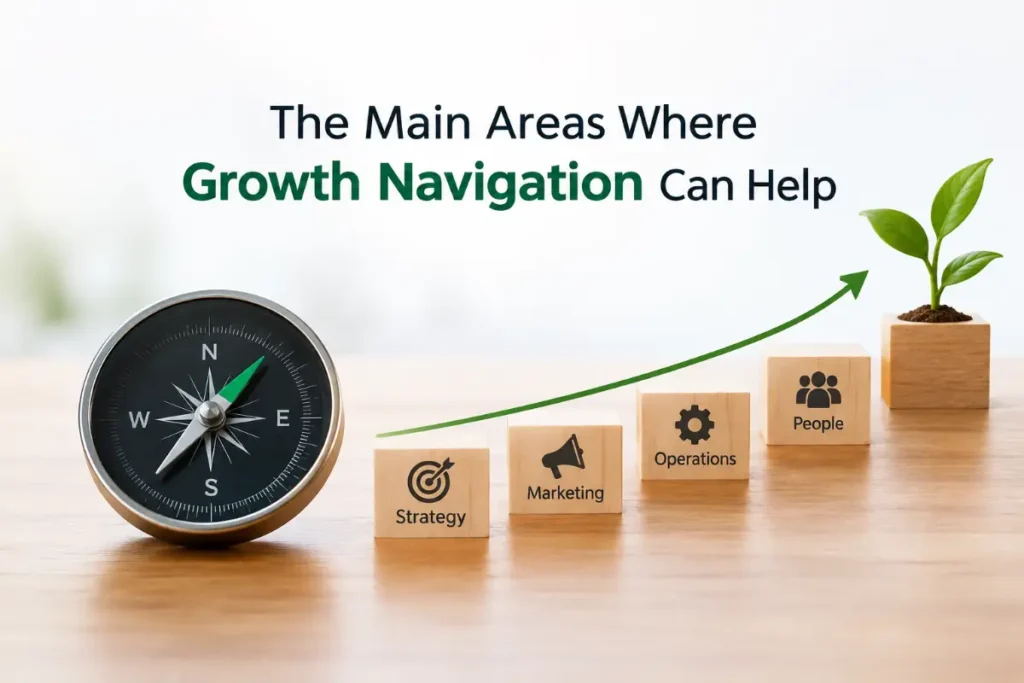
The Main Areas Where Growth Navigation Can Help
The principles behind growth navigation can support several areas of life. The best approach depends on your goals, available resources, and current circumstances.
Personal development
Personal growth involves becoming more aware of your behavior, values, strengths, and limitations. It can include improving emotional awareness, developing confidence, managing time, and building healthier routines.
Start by identifying one area you genuinely want to improve. If you often procrastinate, examine what causes the delay. You might feel overwhelmed by large tasks, lack a clear schedule, or struggle to maintain focus.
Once you understand the cause, you can choose a practical response. Breaking projects into smaller steps may work better than relying on motivation alone.
Personal development becomes more sustainable when your goals reflect your values instead of other people’s expectations.
Career development
Career growth requires more than working hard. It also involves learning which skills matter, understanding workplace expectations, and recognizing opportunities for advancement.
Begin by reviewing your current position. Identify the skills you use confidently and the areas that need improvement. Then compare your abilities with the requirements of the role you want.
You might need technical training, stronger communication skills, leadership experience, or a better professional network.
A clear plan turns career development into a series of manageable actions. It also helps you decide which opportunities deserve your attention.
Business growth
Businesses need direction to grow sustainably. Increasing revenue can be useful, but expansion without planning may create cash flow problems, reduce service quality, or overwhelm employees.
Business leaders should understand their customers, market conditions, operating costs, and competitive position before making major decisions.
For example, a small online store may discover that repeat customers generate more profit than expensive advertising campaigns. Improving customer service and encouraging repeat purchases could be a better investment than expanding its advertising budget immediately.
The central lesson is to understand what drives results before committing more resources.
Learning and education
Students and lifelong learners can apply these principles to improve how they study and retain information.
Instead of trying to learn everything at once, choose a specific outcome. You might aim to improve writing, understand a difficult subject, or become comfortable speaking a new language.
Create a realistic schedule and use active learning methods, such as practice questions, short summaries, and regular review sessions.
Track what you can actually do rather than measuring success only by the number of hours spent studying.
Relationships and communication
Growth also involves learning how to communicate more effectively. Strong relationships require listening, patience, honesty, and a willingness to understand different perspectives.
If misunderstandings happen frequently, pay attention to the patterns behind them. You may need to ask clearer questions, explain your expectations, or give others more time to respond.
Improvement begins with recognizing your own role in a situation. Small changes in communication can make everyday interactions more productive and respectful.
How to Navigate Growth Step by Step
A practical system makes improvement easier to manage. You do not need an elaborate plan or expensive tools. You need a clear objective, useful information, consistent action, and a willingness to adjust.
Step 1. Understand your starting point
Before deciding where to go, examine your current situation.
Ask yourself what is working, what is not working, and what you would most like to change. Be honest about your available time, money, energy, and skills.
A business owner might review monthly revenue and customer feedback. A job seeker might assess their experience and qualifications. Someone working on personal habits might track their daily routine.
This initial assessment creates a realistic foundation for future decisions.
Step 2. Choose a specific goal
Vague goals make progress difficult to measure. A goal such as becoming better at communication offers little guidance until you define the improvement you want.
A more useful goal might be to deliver three work presentations over the next two months and request feedback after each one.
Specific goals give you something concrete to work toward. They also make it easier to recognize progress.
Choose a goal that matters to you and fits your current circumstances.
Step 3. Break the goal into smaller actions
Large objectives can feel intimidating because they involve many different tasks. Dividing them into smaller actions makes the process easier to manage.
Suppose you want to start a small business. Your initial tasks might include researching customer demand, estimating startup costs, choosing a product, and testing your idea with potential buyers.
Each completed task moves you closer to the larger objective.
Small steps also help you build confidence because you can see the results of your effort.
Step 4. Identify obstacles early
Every goal comes with possible difficulties. Some are predictable, such as limited funding or a demanding work schedule. Others appear unexpectedly.
Think about the problems most likely to slow you down and develop a response in advance.
If you have limited time for professional training, schedule shorter sessions throughout the week. If your business depends on one major customer, consider ways to attract additional customers.
Planning for obstacles does not eliminate uncertainty, but it can reduce the disruption they cause.
Step 5. Take consistent action
A plan has value only when you use it. Choose actions that you can repeat without placing unrealistic demands on yourself.
You might spend twenty minutes each day learning a new skill, review business performance every Friday, or set aside time each month to assess your career goals.
Consistency matters because repeated actions create opportunities to practice, learn, and improve.
You do not need to feel motivated every day. A manageable routine can help you continue even when enthusiasm fades.
Step 6. Measure meaningful progress
Use measurements that reflect your actual objective.
A person learning to write might track the quality of their work and feedback from readers. A business owner might monitor profit margins, customer retention, and conversion rates.
Avoid focusing on numbers simply because they are easy to measure. A growing social media audience, for example, does not automatically mean a business is becoming more profitable.
Choose a small number of useful indicators and review them regularly.
Step 7. Adjust your approach
Your first plan may not be the best plan. New information can reveal that an assumption was wrong or that another strategy would work better.
Review your results and ask what they tell you. Keep the actions that produce useful outcomes, improve the ones that fall short, and remove activities that consume resources without delivering value.
Changing your approach is not the same as abandoning your goal. Sometimes the most effective route requires a different method.
Step 8. Recognize progress and keep learning
Take time to acknowledge what you have achieved. Recognizing improvement can strengthen motivation and help you understand which habits are working.
At the same time, avoid assuming that one success guarantees future success. Continue learning, gathering feedback, and responding to new circumstances.
Long term development depends on the ability to improve your methods as your experience grows.
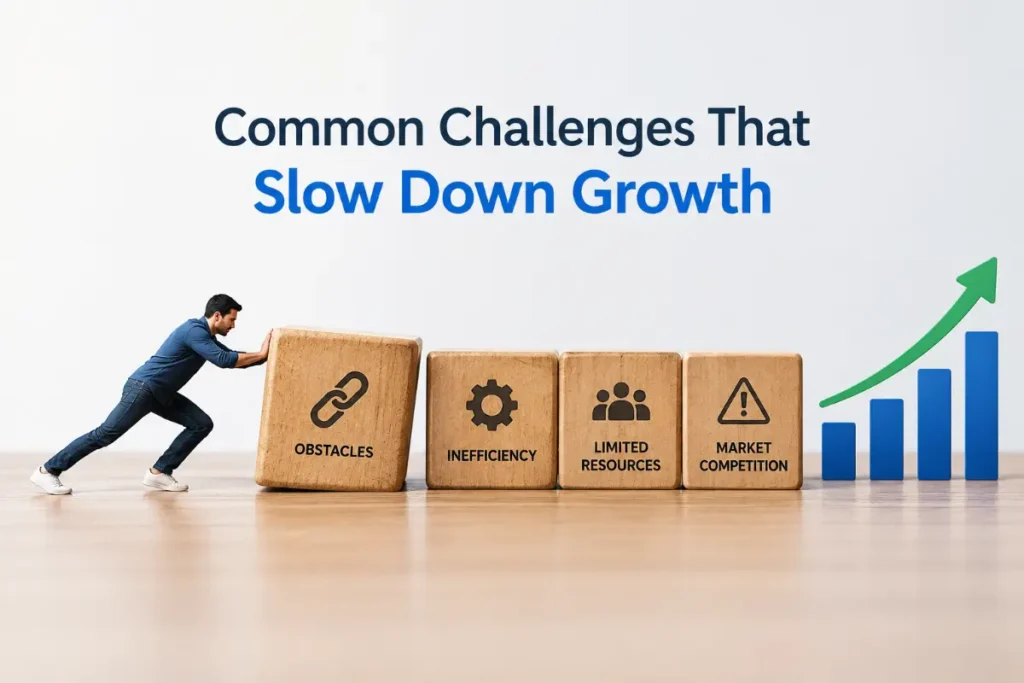
Common Challenges That Slow Down Growth
Even with a clear plan, progress can be difficult. Understanding common obstacles helps you respond to them before they become larger problems.
Setting too many goals
Trying to improve every area of life at once divides your attention. You may begin several projects without giving any of them enough time to produce results.
Choose one or two priorities first. Once they become manageable, you can introduce additional goals.
Comparing yourself with others
Other people’s achievements can provide inspiration, but constant comparison often creates unrealistic expectations.
You rarely see the full story behind another person’s success. Their resources, responsibilities, experience, and opportunities may differ from yours.
Measure your progress against your own starting point and the objectives you have chosen.
Expecting immediate results
Many valuable changes take time. Learning a skill, building a customer base, and developing stronger habits require repeated effort.
If you expect immediate success, ordinary delays may feel like failure. Set realistic expectations and look for smaller signs of improvement along the way.
Ignoring feedback
Feedback can reveal problems that are difficult to recognize on your own. Dismissing criticism may prevent you from discovering better methods.
Look for specific, constructive feedback from people who understand your goals. Consider their observations carefully, but use your judgment before changing your approach.
Refusing to change a plan
Commitment is valuable, but stubbornly following an ineffective strategy wastes time and resources.
Review your assumptions regularly. If the evidence shows that your current method is not working, explore alternatives.
Flexibility allows you to remain committed to the outcome while changing the route.
Practical Ways to Build a Growth Mindset
A growth mindset involves believing that abilities can develop through learning, practice, and useful feedback. It does not mean that effort guarantees success or that every limitation can be removed.
Instead, it encourages you to treat challenges as opportunities to learn.
Start by changing the questions you ask yourself. Rather than thinking that you are bad at a particular skill, identify what you need to practice. Instead of viewing a disappointing result as a final judgment, examine what contributed to it.
You can strengthen this approach through several simple habits.
Keep a learning journal. Write down what you learned, which challenges you faced, and what you plan to do differently next time.
Ask better questions. When something goes wrong, investigate the cause before assigning blame.
Seek useful feedback. Invite honest observations from people who can help you improve.
Practice deliberately. Focus on specific weaknesses instead of repeating familiar tasks without reflection.
Celebrate effort and improvement. Recognize the value of persistence, but also pay attention to the methods and decisions that produce results.
These habits help turn personal development into an ongoing process rather than a temporary burst of motivation.
How Technology Can Support Your Growth
Technology can make planning and progress tracking easier when you use it with a clear purpose.
Digital calendars help you protect time for important tasks. Project management applications can organize complex work into smaller assignments. Budgeting software can help business owners understand expenses and cash flow. Online courses provide opportunities to learn skills without always attending in person.
Artificial intelligence tools can also assist with brainstorming, organizing information, practicing communication, and identifying questions you may have overlooked.
However, technology should support your judgment rather than replace it. A productivity app cannot decide which goals matter most to you. An online recommendation may not account for your personal circumstances. Automated reports can also reflect incomplete or inaccurate information.
Choose tools that solve specific problems. If a tool adds unnecessary steps or distracts you from meaningful work, it may not be worth using.
The best system is one that helps you make better decisions and take action consistently.
Measuring Success Beyond Money and Achievement
Success is often measured through income, promotions, business revenue, or public recognition. These measures can be useful, but they do not capture every part of a fulfilling life.
Personal progress can also include better health habits, stronger relationships, greater confidence, improved decision making, and more control over your time.
For a business, sustainable success may involve satisfied customers, reliable employees, healthy cash flow, and the ability to adapt during difficult periods.
Consider what a successful outcome would look like before choosing your measurements. A person who values work life balance may not benefit from a promotion that requires constant overtime. A business that wants long term stability may choose slower expansion over risky rapid growth.
Your measures of success should reflect your actual priorities.
It is also helpful to review those priorities occasionally. Responsibilities and circumstances change, and your definition of meaningful progress may change with them.
A Simple Growth Plan You Can Start Today
You can put these ideas into practice without waiting for the perfect moment.
Begin with a short planning exercise. Choose one area where improvement would make a meaningful difference, then answer five questions.
- What do I want to improve?
- Why does this improvement matter to me?
- What is currently preventing progress?
- What small action can I take this week?
- How will I know that I am making progress?
Write down your answers and choose a realistic deadline for your first milestone.
For example, someone who wants to improve their professional writing might set a goal to complete one focused writing exercise each weekday for four weeks. They could review their work every Friday and ask a colleague for feedback at the end of the month.
A business owner might choose to contact five existing customers, learn why they continue buying, and use that information to improve customer service.
The exact activity matters less than the quality of the process. Start with a meaningful goal, act on useful information, and learn from the results.
Review your plan weekly. Keep what works and make small changes when needed. After completing your first milestone, decide on the next step.
Frequently Asked Questions
What is growth navigate?
Growth navigate is a phrase that can describe finding a clear direction while working toward personal, professional, or business improvement. It combines the idea of developing over time with the process of choosing a path and responding to challenges. The phrase does not have one universally accepted technical definition, so its meaning depends on the context in which it is used.
How can I apply growth navigation to my life?
Start by identifying one area you want to improve. Define a specific goal, assess your current situation, and choose manageable actions. Track your progress and review your results regularly. If your original approach is ineffective, adjust it based on what you learn. This process can help you make thoughtful decisions and maintain steady progress.
Why is direction important for personal growth?
Direction helps you focus your time and energy on goals that matter. Without a clear objective, you may spend considerable effort on activities that do not produce meaningful results. A defined direction gives you a basis for making decisions, measuring improvement, and deciding when to change your approach.
Can businesses use growth navigation strategies?
Yes. Businesses can apply these principles to customer research, financial planning, product development, employee training, and market expansion. Leaders can identify an objective, study current performance, test possible solutions, and measure the results. This approach encourages informed decisions and helps organizations respond to changing customer needs.
How do I measure personal growth?
Measure personal growth through outcomes that match your goals. These might include improved communication, greater confidence, stronger habits, new skills, or better time management. Use specific indicators when possible, and compare your current performance with your earlier progress. Regular reflection can also help you identify changes that numbers alone cannot capture.
What is the biggest obstacle to growth?
There is no single obstacle that affects everyone. Common challenges include unclear goals, inconsistent effort, unrealistic expectations, fear of failure, and resistance to feedback. The most useful response is to identify the specific problem affecting your progress and address its underlying cause rather than relying on motivation alone.
How long does personal growth take?
The timeline depends on the goal, the resources available, and the amount of practice required. A simple daily habit may become easier within a few weeks, while mastering a professional skill can take months or years. Focus on realistic milestones and consistent improvement instead of expecting every change to happen on the same schedule.
Can growth happen without a detailed plan?
Yes. Some opportunities develop unexpectedly, and exploration can lead to valuable discoveries. However, having at least a basic direction can help you use your time more effectively. You do not need to plan every detail in advance. A flexible goal and a few practical next steps are often enough to get started.
How can I stay motivated during slow progress?
Break large goals into smaller milestones, track improvements, and maintain a realistic routine. Remind yourself why the goal matters, and look for feedback that helps you recognize progress. When motivation declines, reduce unnecessary complexity and focus on the next manageable action. Consistent routines can help you continue during periods when enthusiasm is limited.
What is the first step toward meaningful growth?
The first step is understanding your current situation and identifying what you want to improve. Be specific about the outcome you hope to achieve and why it matters. Then choose one practical action you can take soon. Starting with a manageable step makes it easier to build momentum, learn from experience, and develop a more effective plan.
Final Thoughts
Meaningful progress requires more than ambition. It calls for direction, consistent action, honest reflection, and the ability to learn from experience.
The idea behind growth navigate is simple: understand where you are, decide where you want to go, and make informed choices that bring you closer to your goal. When circumstances change, adjust your approach without losing sight of your priorities.
You do not need to solve every problem today or create a perfect plan before beginning. Choose one meaningful goal, take a practical first step, and learn from the outcome.
Over time, those small decisions can help you build stronger habits, improve your skills, make better business choices, and create progress that lasts.